 Desktop workbench for empirical social science
One project file, from the first citation to the replication package.
Your literature, your data, your estimates and your manuscript, held together with the evidence that connects them.
Every figure in the text resolves to the run that produced it. Export waits until all of them do.
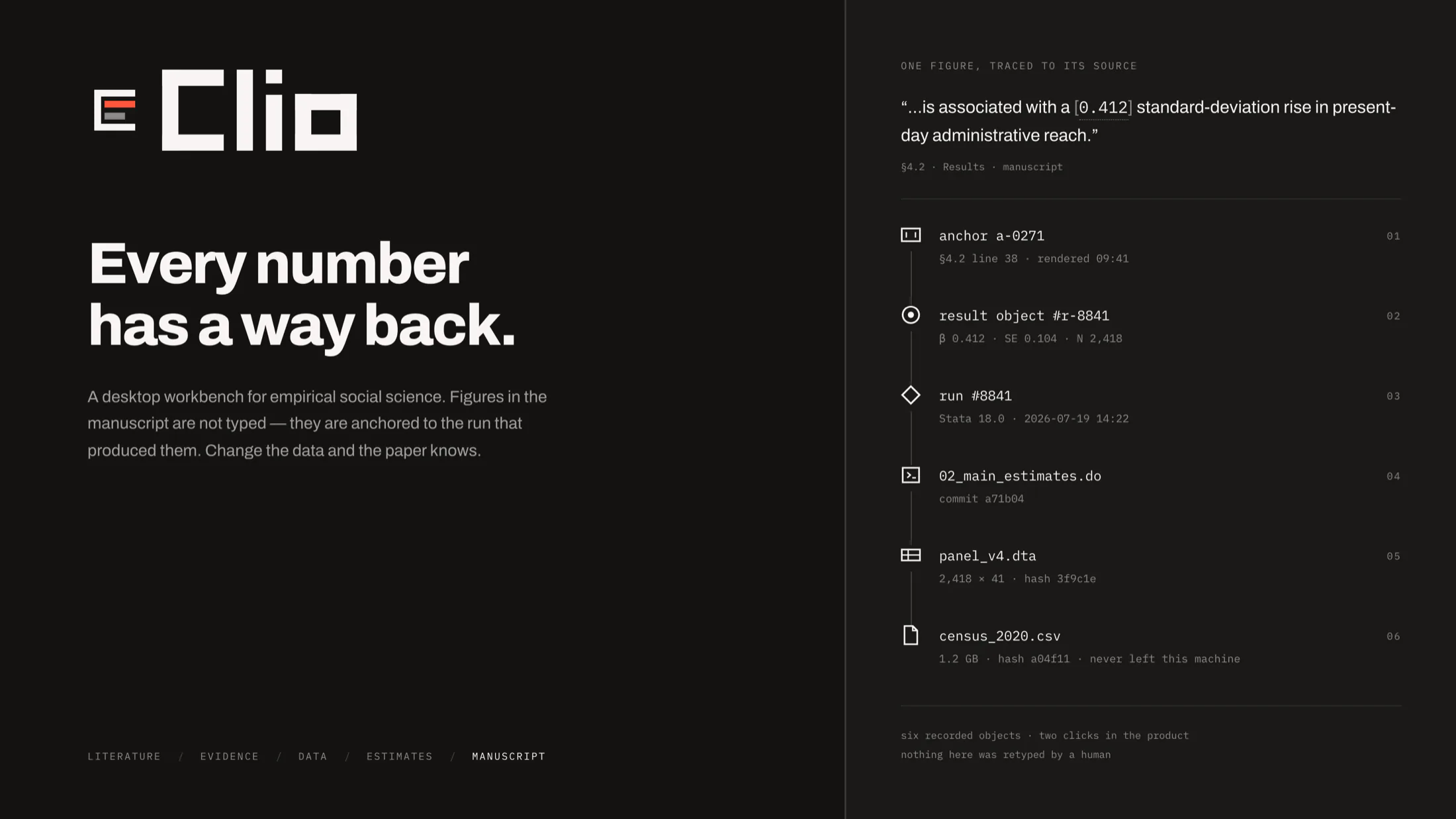
The analysis got faster. The paper still takes just as long to finish.
A 2026 survey of 1,260 quantitative social scientists found that those working with coding agents post more working papers than their peers. Journal submissions stayed where they were.
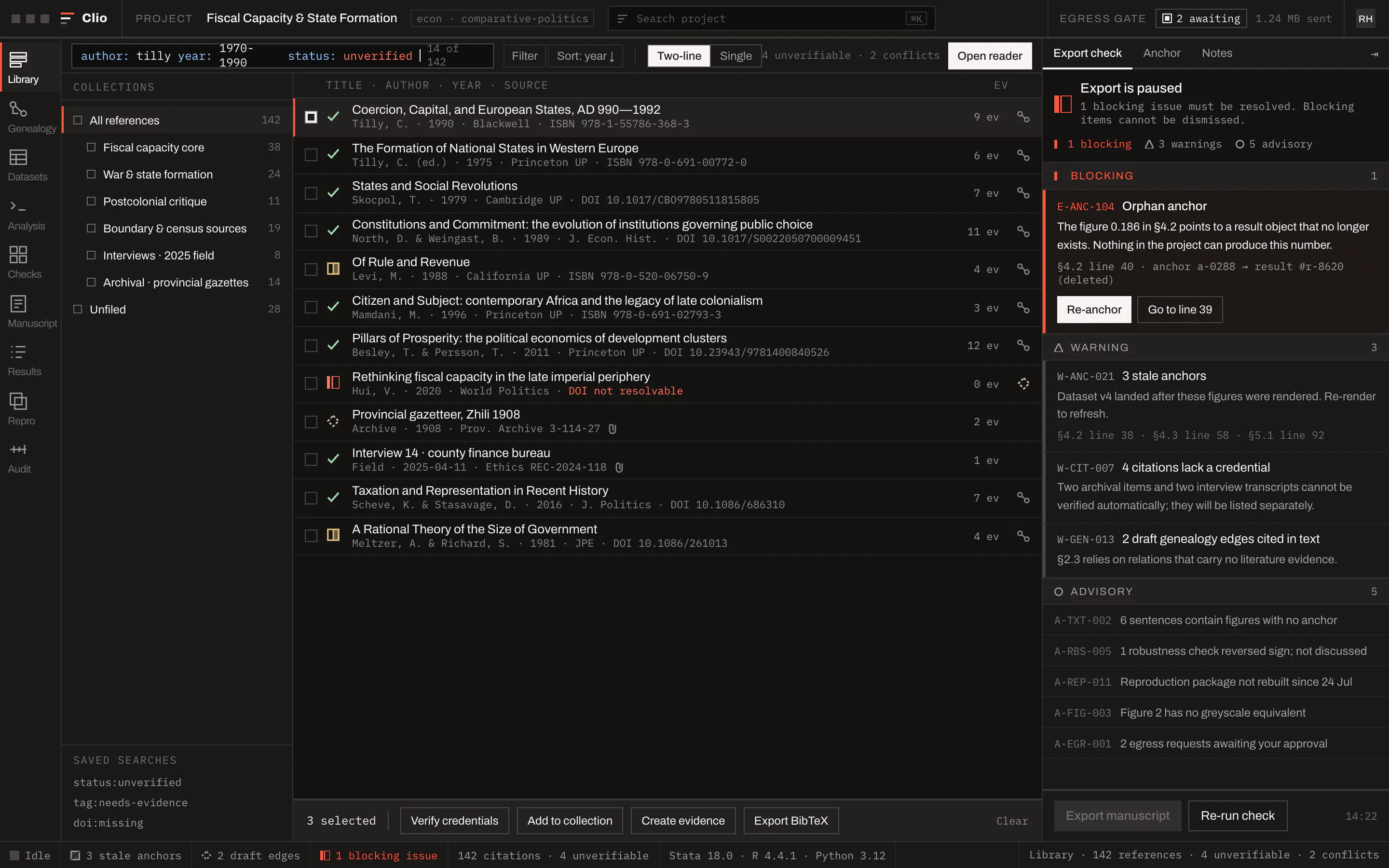
Every reference is checked on the way in.
Clio pulls from Zotero, EndNote or BibTeX and looks for an identifier a third party could resolve. Whatever resolves is marked verified. Whatever stops short is flagged in the list, in place, where you will see it before it reaches your bibliography.
Social science runs on more than DOIs.
| kind | used for | checkable |
|---|---|---|
| doi | Journal articles | Yes |
| isbn | Monographs | Yes |
| handle | Repositories, dissertations | Yes |
| arxiv / ssrn / repec | Preprints, working papers | Yes |
| url_archived | Web sources | Yes |
| legal | Statutes, cases, records | Partly |
| custodial | Archives, manuscripts | No · appendix |
| fieldwork | Interviews, field material | No · appendix |
Archival and field material has no external register to check against. Clio lists it in a separate appendix and keeps it out of the verified count.
A theory claim carries the literature behind it, or it stays out of the manuscript.
Clio lays out the descent of your field on a time axis, in swimlanes by school. Scholars, concepts, propositions and works each take their own outline; the eight kinds of relation each take their own stroke. Attach evidence and the edge draws solid. Leave it empty and the edge draws as a draft, stays out of the text, and keeps a count at the foot of the canvas.
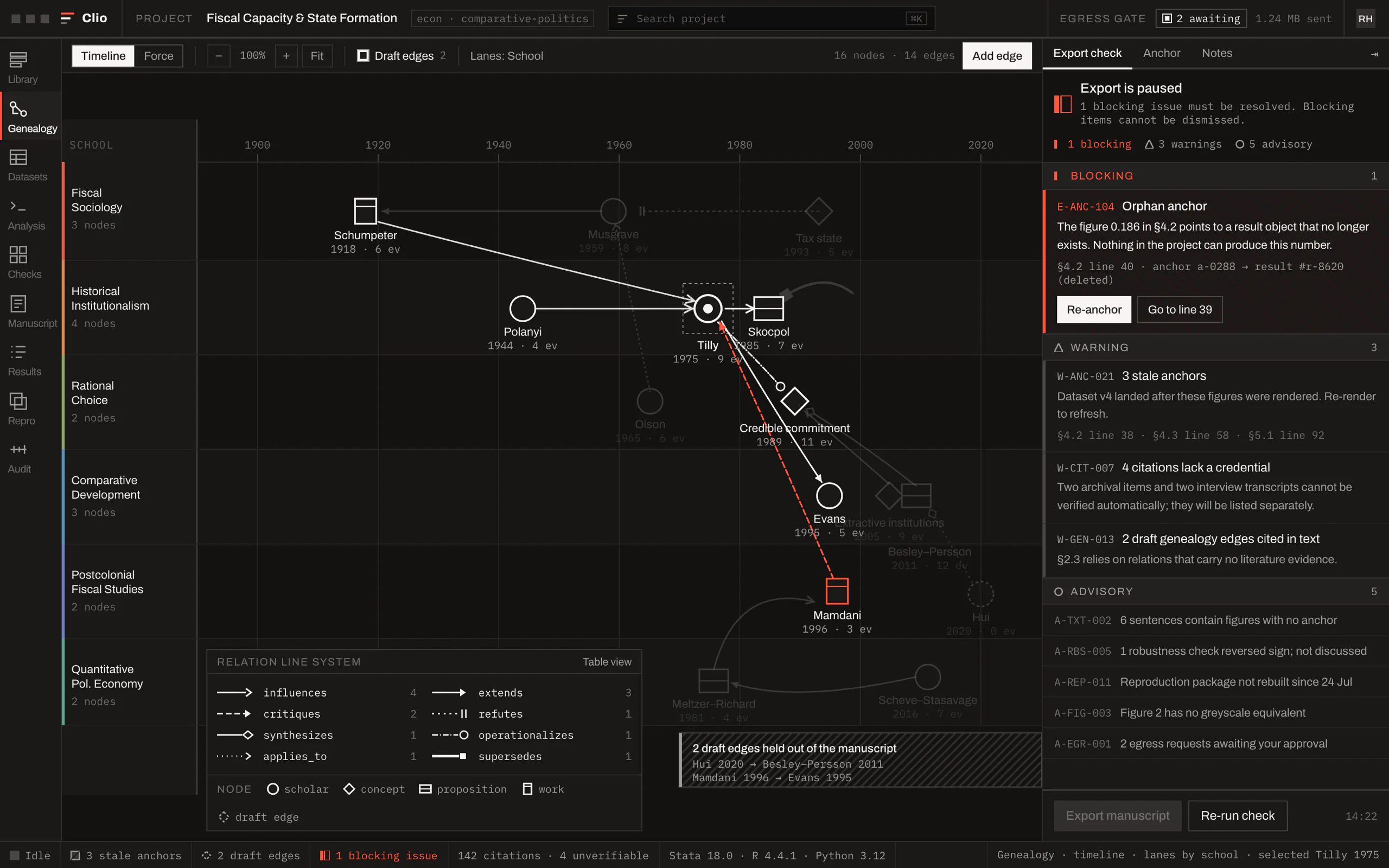
influences · extends · critiques · refutes · synthesizes · operationalizes · applies to · supersedes
scholar · concept · proposition · work — each with its own outline, so the graph reads in greyscale
Draft relations are counted at the foot of the canvas and again in the status bar.
Every run keeps what produced it. Every specification stays in the table.
A run becomes a result object: coefficients, model specification, dataset version, seed, interpreter and every package version, held together.
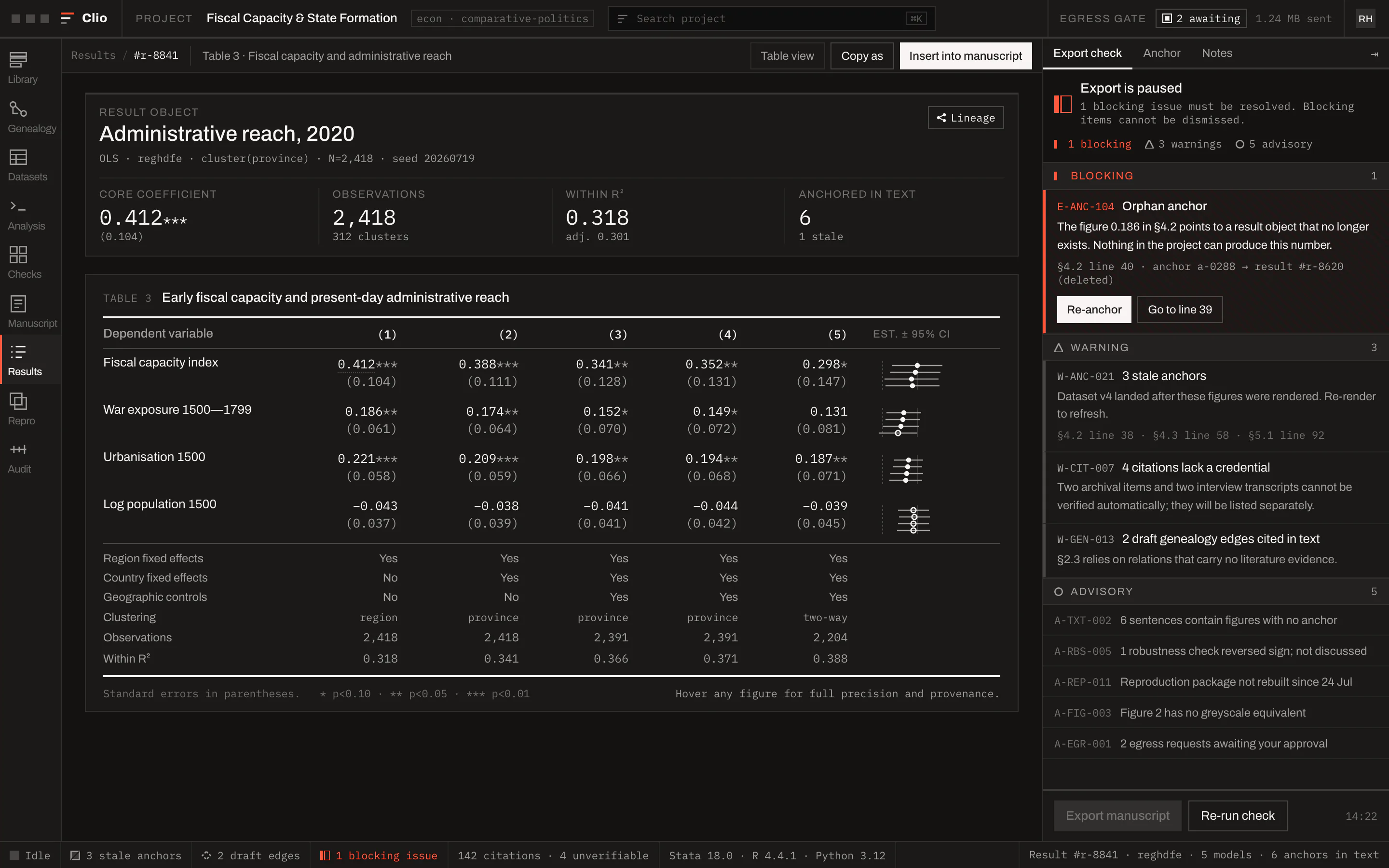
Clio reads your identification strategy, derives the checks it calls for, and runs all of them. Sign reversals and lost significance carry texture, glyph and colour at once, so they survive greyscale printing.
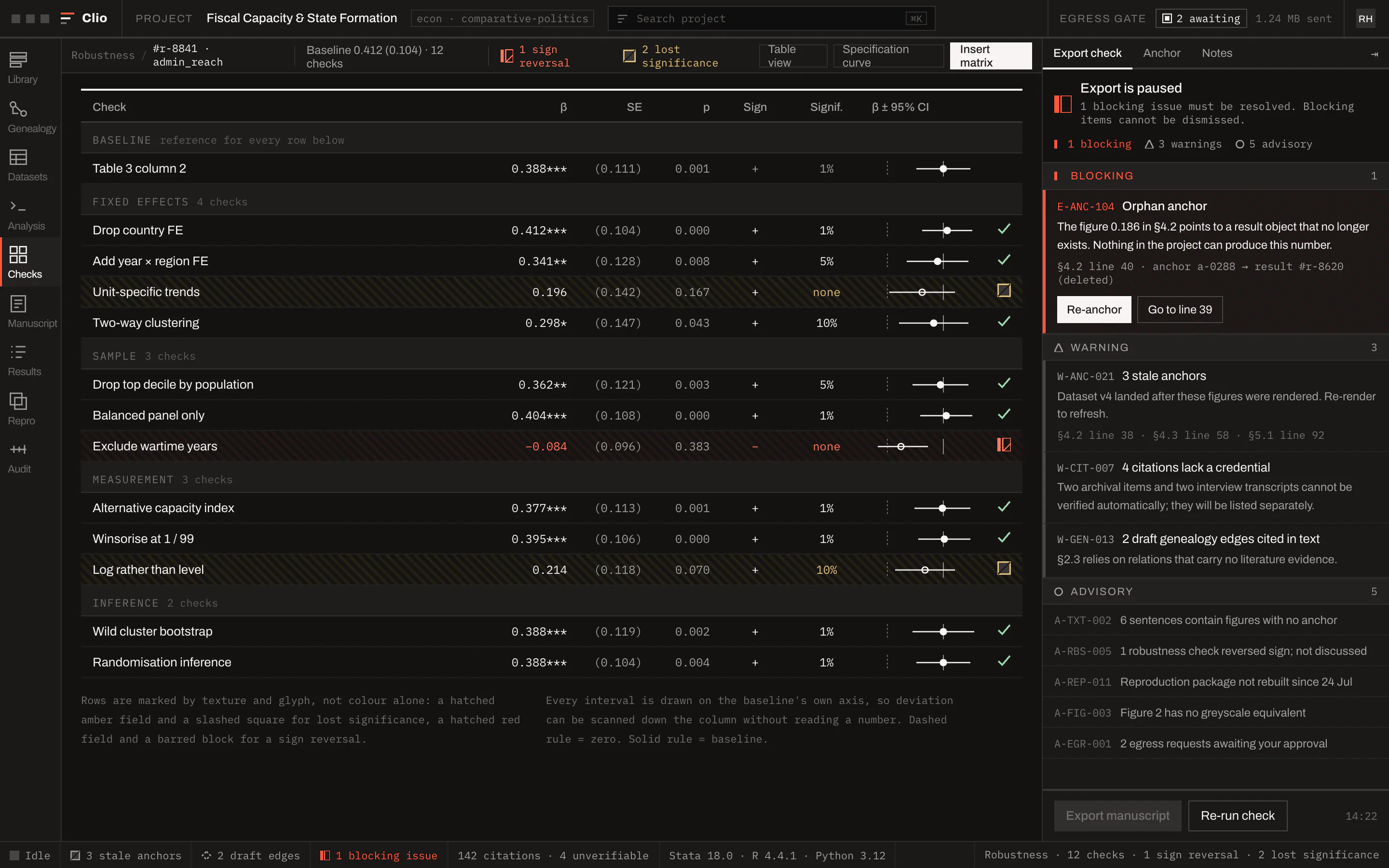
“There is no filter that removes the row you did not like.”
The package is verified against the numbers your manuscript prints. Clio rebuilds it in a clean environment, reruns it, and compares every anchored figure to what the paper says.
We publish where we fail — pass rates by discipline, by method and by language, including the methods Clio handles badly.
Write the reference. Clio prints the figure.
A bracketed reference — [ ] — resolves to a field on a result object. Rerun the analysis and the bracket turns; the line number in the gutter turns with it. Delete the result and the anchor goes orphan, and export waits until you deal with it.
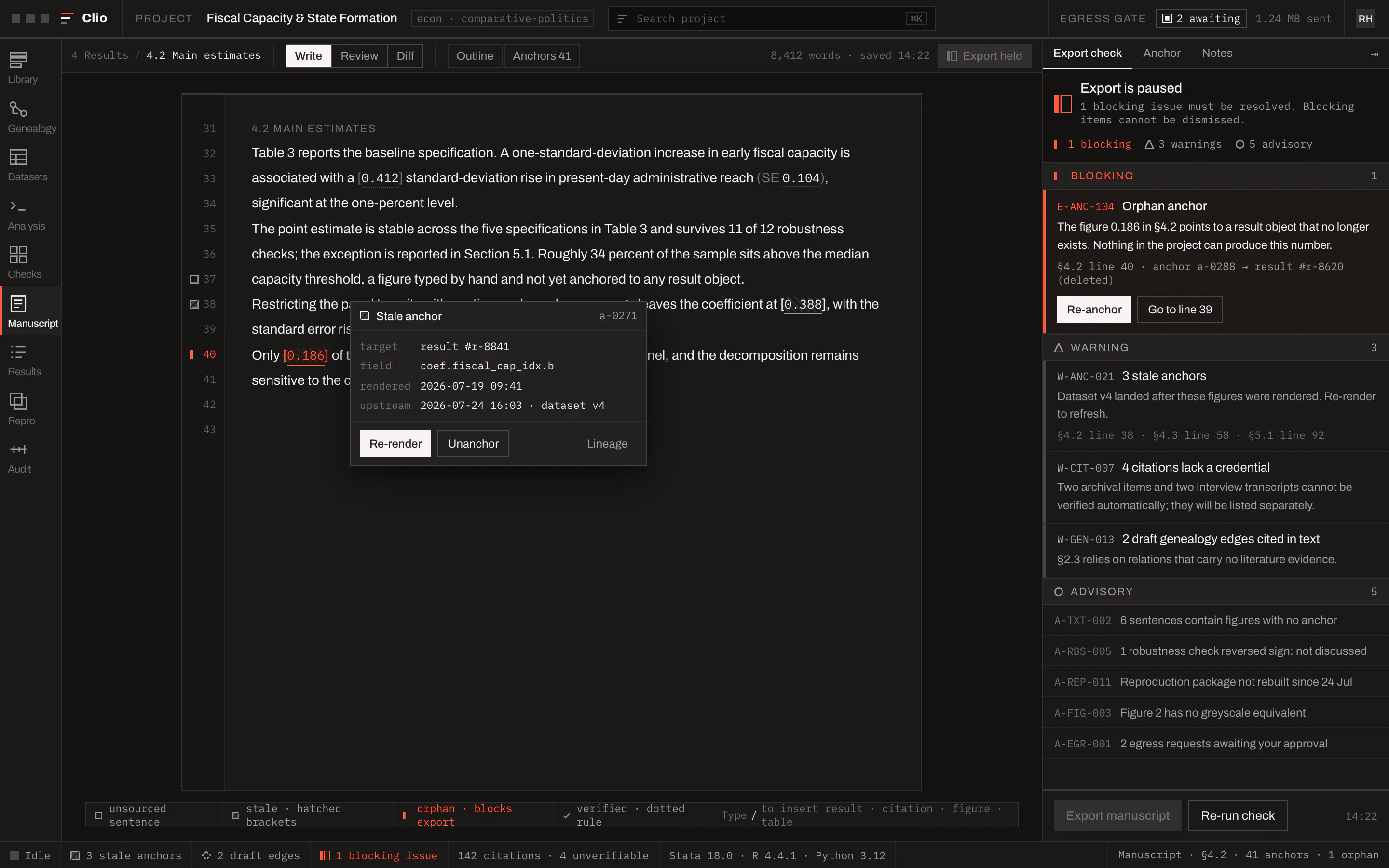
- current
- Matches its source.
- stale
- Upstream changed after this was rendered.
- orphan
- The source is gone. Export is held.
- unsourced
- A sentence carries a figure with no anchor at all.
It runs on your machine. It waits for you before it acts, and before it exports.
When a step needs a model, the request enters a queue: what it is for, which host, how many bytes, and the payload itself, in full, for you to read. Raw rows from restricted microdata stay out of that payload.
raw dataset rows · full texts · interview transcripts · scans · result payloads
-
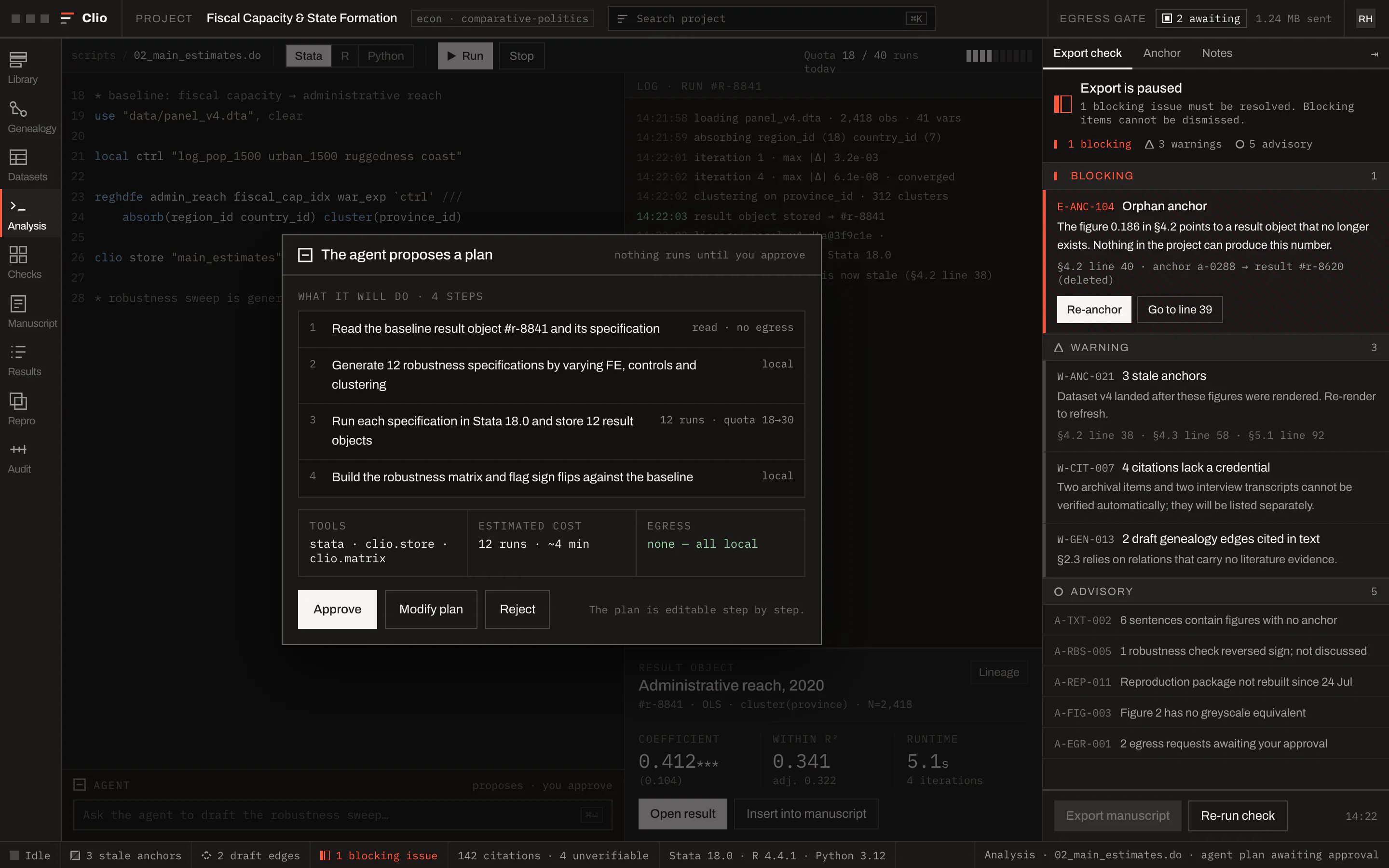
The agent proposes a plan. You approve it, change it, or refuse it. The setting that would let it act on its own reads zero, and is enforced.
-
Section drafting works from evidence you collected and results you ran. An empty project produces an empty manuscript.
-
Blocking findings have no dismiss control. They clear when they are fixed.
Reserve a place in the preview.
macOS 13+ first · Windows 11 and Ubuntu 22.04+ to follow · 16 GB recommended
Your own Stata, R or Python installation
Your name, your email and where you work. We ask about the project when we write back.
A preview build, a reproduction report on your own project, and a direct line to the team.
Thank you — your request is in.
We read every one of these ourselves. You will hear from us at the address you gave, usually within a few days. When we write back we will ask about your field, your identification strategy and the paper you are stuck on, so we can tell you honestly what a preview can cover.
Only if your analysis is written in Stata. Clio drives the copy you already have installed; it does not resell or bundle a licence. R and Python need none, and one project can mix all three.
Stata, R and Python, driven through your own installation. The supported version range for the first release is being fixed with engineering and will be published with the preview build, along with the interpreter and package versions each run records.
Only in a request you approved. You can point Clio at a local model, or at your institution’s own endpoint, and never at a public one. The log keeps the purpose, host, byte count and payload of every approved request. Refuse one and the step stops there; nothing is queued, retried or sent later.
It stays where it is and is never copied into the package. Clio records the dataset version, the access route and the conditions of use, and ships the code with a data-access statement in place of the file.
Discipline packs carry the methods, journal templates, appraisal instruments and worked examples of one field, each maintained with a methodologist from it. The core — project model, evidence chain, result objects, audit log — is discipline-neutral and does not wait for a pack.
It carries the administrative change events for one jurisdiction — merges, splits, code reassignments, boundary revisions — and converts any vintage to any other. Panels that cross a revision receive a confidence grade in a column, so a regression can condition on it. United States, European Union and Japan first.
Yes. Clio imports from both and can keep a Zotero library in step. References are checked for a resolvable credential on the way in, and anything unverifiable arrives in the list flagged, where you will see it.
Yes, with anchored figures as live fields in Word and macros in LaTeX. Tables export as native table objects, and the manuscript keeps its anchor map so a later rerun can update the exported file.
Yes for coding, memoing and evidence attachment on interviews, documents and field notes. Transcripts never leave the machine, and automated inference over them is limited to what you can audit line by line.
The output is an ordinary Word or LaTeX manuscript with an ordinary replication package, so nothing about it is unusual to a journal. The package is assembled to the data-availability requirements your target journal publishes, and you can read the checklist it was built against before you submit.
Clio logs every agent step you approved, with the model, the purpose and the bytes sent, and drafts a disclosure statement from that log in the form your target journal asks for. You edit and sign it; nothing is submitted on your behalf.
Pricing is not set. The preview carries no charge, and preview participants will be told the terms before anything changes.